Database Open Access
Respiratory and Pulse Oximetry Waveforms from Healthy Adults During Simulated Apnoea Events
Jordan Hill , Ella Frances Sophia Guy , Jaimey Anne Clifton , Chris Pretty , James Geoffrey Chase
Published: March 4, 2026. Version: 1.0.0
When using this resource, please cite:
Hill, J., Guy, E. F. S., Clifton, J. A., Pretty, C., & Chase, J. G. (2026). Respiratory and Pulse Oximetry Waveforms from Healthy Adults During Simulated Apnoea Events (version 1.0.0). PhysioNet. RRID:SCR_007345. https://doi.org/10.13026/s45r-k263
Please include the standard citation for PhysioNet:
(show more options)
Goldberger, A., Amaral, L., Glass, L., Hausdorff, J., Ivanov, P. C., Mark, R., ... & Stanley, H. E. (2000). PhysioBank, PhysioToolkit, and PhysioNet: Components of a new research resource for complex physiologic signals. Circulation [Online]. 101 (23), pp. e215–e220. RRID:SCR_007345.
Abstract
This dataset contains airway gauge pressure, inspiratory differential pressure, and pulse oximetry waveforms collected from 20 healthy adult participants (10 females, 10 males) during simulated obstructive sleep apnoea (OSA) trials. Recordings include photoplethysmography (PPG) signals from a custom neck-worn reflectance oximeter, which records both arterial and venous blood waveforms from the carotid artery and internal jugular vein, respectively. Each subject completed a a series of 8 × 60-second breathing trials with varying positive airway pressures (0, 4, and 8 cmH₂O) set with a continuous positive airway pressure (CPAP) device. Normal breathing was recorded initially before subsequent trials of three breaths followed by 10- and 20-second breath holds, before normal breathing for the rest of the 60 seconds. The dataset is structured to support algorithm development and validation for OSA detection, modelling of airway resistance and oxygen desaturation responses, and non-invasive estimation of arterial and venous oxygen saturation. Supplementary code and figures are included to facilitate data analysis.
Background
Obstructive sleep apnoea (OSA) is a prevalent respiratory disorder characterised by repetitive episodes of partial or complete upper airway obstruction during sleep [1, 2]. These events cause intermittent reductions (hypopneas) or cessations (apnoeas) of airflow, leading to disrupted sleep [1]. Apnoea is defined as a complete cessation of airflow lasting at least 10 seconds, whereas a hypopnea involves a partial reduction in airflow by at least 30% accompanied by a 4% or greater oxygen desaturation [1-3]. The severity of OSA is quantified using the apnoea–hypopnea index (AHI), which reflects the average number of apnoea and hypopnea events per hour of sleep and informs clinical diagnosis and treatment plans [2].
CPAP therapy remains the gold standard treatment for OSA, delivering pressurised air to maintain an open airway during sleep [3-5]. Current auto-titration PAP (APAP) devices adjust pressure based on algorithms primarily triggered by detected apnoeas [5, 6]. However, these devices often do not detect or respond adequately to earlier or more subtle respiratory events, such as hypopneas, oxygen desaturations, or increased airway resistance. Thus, the ability to intervene earlier or optimise care is lost.
The standard clinical diagnosis of OSA relies on overnight polysomnography, a resource-intensive and costly procedure that can limit accessibility and delay timely intervention [7, 8]. To support the development of novel, less burdensome diagnostic and monitoring tools, this dataset was collected from healthy adult volunteers undergoing normal relaxed breathing with simulated apnoeas through breath holds under varying positive end-expiratory pressures (PEEP). The dataset includes synchronised respiratory and pulse oximetry waveforms recorded under standardised, repeatable conditions without involving clinically diagnosed OSA patients. These data aim to facilitate the development of improved signal processing, model-based, and machine learning tools for early detection, personalised monitoring, and more optimal diagnosis and management of OSA outside traditional clinical settings.
Methods
This dataset was collected as part of a small pilot study investigating the relationship between upper airway pressure, respiratory flow, and oxygen saturation during simulated apnoea events in healthy adults. Measurements were taken from 20 participants (10 females, 10 males) across a series of tests using a combination of custom-designed and commercial sensors. All participants were students at the University of Canterbury, Christchurch, New Zealand.
A custom-built inline airway sensor captured gauge pressure and inhalation differential pressure at the airway. The inline sensor consists of a simple biocompatible 3D-printed venturi tube connected in series with a filter and a full-face mask. The downstream end of the venturi was connected to a CPAP device (SleepStyle SPSCAA; Fisher & Paykel Healthcare, Auckland, NZ), which delivered constant positive airway pressure at 0, 4, and 8 cmH₂O during the tests.
A custom flexible, reflectance pulse oximeter was developed to detect pulsatile signals from both the carotid artery and internal jugular vein (IJV) in the neck [9]. The device contained 8 LEDs (dual package with red, 660nm, and infrared, 940nm, wavelengths) arranged symmetrically around four photodiodes. The sensor was secured on the right side of the neck using medical tape, with placement guided by ultrasound to identify the carotid artery and IJV.
Each photodiode channel captured reflected light intensity from nearby tissue for alternating 660nm and 940nm wavelengths. The raw PPG signals were recorded as analogue voltages for each trial. A combination of arterial and venous waveforms along with breathing modulations is detected, allowing for estimation of heart rate, respiratory rate, arterial saturation (SpaO₂), venous saturation (SpvO₂) and oxygen extraction ratio (O₂ER) during post-processing of the data.
Continuous arterial oxygen saturation (SpaO₂) and heart rate [bpm] were measured using a commercial transmission pulse oximeter (SAT801+, Bitmos GmbH, Düsseldorf, Germany) placed on the right index finger to provide a clinical standard reference. The device reported stable signals throughout all trials. No oxygen desaturation events were detected via the finger oximeter for any subject. For each participant, average SpaO₂ and heart rate values were computed over the test duration and are included in the demographic datasheet. No invasive reference for venous saturation was used. SpaO₂ from the finger was considered the gold standard reference for arterial saturation.
Each subject completed separate tests simulating normal breathing and apnoea events under varying PEEP levels. All 8 tests were 60 seconds in length. Apart from test 1, which was conducted upright, tests 2-8 were conducted in a recumbent position, with participants breathing through a full-face mask connected to the CPAP system with the inline sensor attached. The neck sensor was attached for all trials. The sequence of tests occurred as follows:
- Baseline breathing with no mask or PEEP applied in an upright position. Only pulse data were collected from the neck sensor
- Steady breathing through the inline sensor at 0 cmH₂O PEEP (ZEEP)
- Steady breathing through the inline sensor 4 cmH₂O PEEP
- Three normal breaths followed by a 10-second breath-hold (timed by subject using a handheld stopwatch), followed by normal breathing for the rest of the 60-second period at 4 cmH₂O PEEP
- Three normal breaths followed by a 20-second breath-hold (timed by subject using a handheld stopwatch), followed by normal breathing for the rest of the 60-second period at 4 cmH₂O PEEP
- Steady breathing through the inline sensor 8 cmH₂O PEEP
- Three normal breaths followed by a 10-second breath-hold (timed by subject using a handheld stopwatch), followed by normal breathing for the rest of the 60-second period at 8 cmH₂O PEEP
- Three normal breaths followed by a 20-second breath-hold (timed by subject using a handheld stopwatch), followed by normal breathing for the rest of the 60-second period at 8 cmH₂O PEEP
The above list covers the 8 total tests per participant. Data were collected from both sensors for tests 2-8; test 1 collected only pulse data, with no corresponding breathing data.
The dataset is structured with each trial stored in an individual file, clearly labelled with subject ID, trial type (breath-hold duration), and PEEP level. All measurements were recorded simultaneously across the sensor devices for easy signal comparison. Time information was originally recorded as full date-and-time stamps for each sample. To de-identify the data, these were converted to seconds since the start of recording, removing absolute dates while preserving relative timing.
Participants completed a background questionnaire to self-report sex, age, smoking/vaping status, asthma history, and perceived physical fitness. Physical measurements were taken for height [cm], weight [kg], and neck circumference [cm] using standard equipment. BMI was calculated from these values. These variables were included to support subgroup analyses of how demographic and anatomical features affect oxygenation and respiratory pressures.
Data Description
Data were collected from 20 healthy adult subjects (10 females, 10 males). Demographic details for each participant are provided in the CSV file (Demographic_Data.csv), including sex [M/F], age [years], height [cm], weight [kg], body mass index, neck circumference [cm], and self-reported information on general fitness, smoking, vaping, and asthma history.
Each data file is named using a standardised format which indicates the subject number (‘1’ through to ‘20’), the applied PEEP level (0, 4, or 8 cmH₂O), and the breathing condition or trial type (normal, apnoea1, or apnoea2 where apnoea1 represented the 10-second breath-hold and apnoea2 the 20-second breath-hold). For example, Subject3_0cmH2O_normal corresponds to Subject 3’s recording during normal breathing at 0 cmH₂O airway pressure, while Subject3_4cmH2O_apnoea1 represents the first apnoea event trial with a 10-second breath-hold for the same subject at 4 cmH₂O pressure. The pulse data from the neck sensor is named in the same format, with _pulse added at the end to differentiate between the two. The pulse data also include a Subject_Baseline file, which corresponds to test 1 with the subject breathing with no mask or PEEP applied.
The dataset is organised into three main folders and one top-level CSV file:
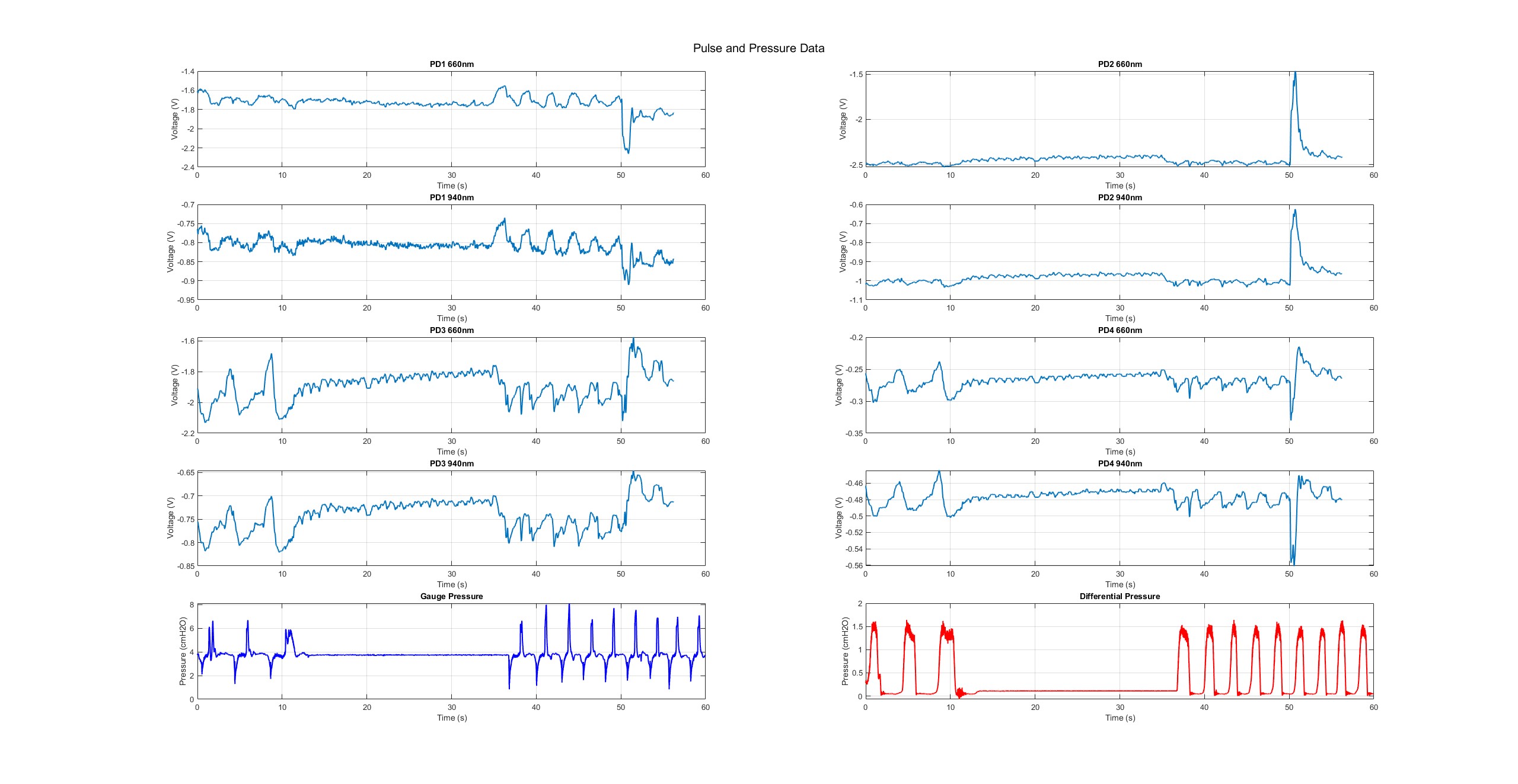
Neck_Pulse_Oximeter_Data- Contains raw PPG data collected from the custom reflectance sensor positioned on the neck. The sensor provides time in seconds and 8 voltage readings for each read, four at 660nm and four at 940nm.Inline_PQ_Data– Contains gauge pressure and inspiratory differential pressure, along with time and recording start time. TheStart timecolumn contains a MATLAB datenum representing the absolute start of the recording. This numeric value can be converted to a clock time by interpreting the integer part as days and the fractional part as the fraction of a 24-hour day, allowing reconstruction of the recording’s start time if needed as performed inplotting_code.m.Demographic_Data.csv– Top-level CSV file summarising participant demographic and background data. Variables are indexed by subject number.Code- Contains MATLAB scripts for importing and plotting the raw data, along with filtering the data. Example figures of the processed dataset for Subject 1 trial 4 (Figure1.png) and trial 6 (Figure2.png) are included.
Usage Notes
This dataset was collected to support the development and validation of algorithms and signal processing techniques aimed at improving the detection and modelling of OSA. The breathing trials performed by 20 healthy adult participants provide a well-defined, repeatable set of respiratory and oximetry signals under varying applied PEEPs and simulated apnoea events (breath-holds). This dataset has not yet been published or used in prior studies, with related manuscripts currently in preparation. It is suitable for validating machine learning models, developing real-time monitoring tools, and investigating signs for early OSA detection and personalised treatment. The data collection and processing, including MATLAB code, are provided openly with the dataset to facilitate reproducibility and extension by other researchers.
Users should note that data were collected from 20 healthy adults simulating OSA events, not from diagnosed patients. The neck reflectance sensor is uncalibrated. Arterial saturations can be compared to a commercial finger sensor. However, venous saturation estimates lack invasive reference validation. Signal quality may be affected by motion, irregular breathing, and mixing of arterial and venous signals. Tidal volume estimates may be impacted by mask leakage and sensor constraints, and airflow signals at zero pressure show reduced flow due to the absence of PEEP.
Release Notes
Version 1.0.0: Initial release of the dataset.
Ethics
Ethical approval for the trial was granted by the Human Research Ethics Committee at the University of Canterbury (Ref: HREC 2024/163/LR-PS). Subjects gave written consent before the trial after both written and verbal explanations of the procedure. Subjects consented to the publication and open-source sharing of their de-identified data
Acknowledgements
This work was funded by a University of Canterbury Doctoral Scholarship and Te Tītoki Mataora RAP I Programme.
Conflicts of Interest
The authors have no conflicts of interest to declare.
References
- Qureshi A, Ballard RD, Nelson HS. Obstructive sleep apnea. J Allergy Clin Immunol. 2003;112(4):643-651. doi:10.1016/j.jaci.2003.08.031.
- Gottlieb DJ, Punjabi NM. Diagnosis and management of obstructive sleep apnea: a review. JAMA. 2020;323(14):1389-1400. doi:10.1001/jama.2020.3514.
- Dempsey JA, Veasey SC, Morgan BJ, O'Donnell CP. Pathophysiology of sleep apnea. Physiol Rev. 2010;90(1):47-112. doi:10.1152/physrev.00043.2008.
- Abbasi A, et al. A comprehensive review of obstructive sleep apnea. Sleep Sci. 2021;14(2):142-154. doi:10.5935/1984-0063.20200056.
- Patil SP, Ayappa IA, Caples SM, Kimoff RJ, Patel SR, Harrod CG. Treatment of adult obstructive sleep apnea with positive airway pressure: an American Academy of Sleep Medicine clinical practice guideline. J Clin Sleep Med. 2019;15(2):335-343. doi:10.5664/jcsm.7640.
- Natsky AN, Vakulin A, Chai-Coetzer CL, McEvoy RD, Adams RJ, Kaambwa B. Preferred attributes of care pathways for obstructive sleep apnoea from the perspective of diagnosed patients and high-risk individuals: a discrete choice experiment. Appl Health Econ Health Policy. 2022;20(4):597-607. doi:10.1007/s40258-022-00716-1.
- Caples SM, Anderson WM, Calero K, Howell M, Hashmi SD. Use of polysomnography and home sleep apnea tests for the longitudinal management of obstructive sleep apnea in adults: an American Academy of Sleep Medicine clinical guidance statement. J Clin Sleep Med. 2021;17(6):1287-1293. doi:10.5664/jcsm.9240.
- Rosenberg R, Hirshkowitz M, Rapoport DM, Kryger M. The role of home sleep testing for evaluation of patients with excessive daytime sleepiness: focus on obstructive sleep apnea and narcolepsy. Sleep Med. 2019;56:80-89. doi:10.1016/j.sleep.2019.01.014.
- Hill JF, Campbell J, Chase JG, Pretty CG. Estimation of venous oxygen saturation through non-invasive optical sensing at the jugular veins. Curr Dir Biomed Eng. 2024;10(4):295-298. doi:10.1515/cdbme-2024-2072.
Access
Access Policy:
Anyone can access the files, as long as they conform to the terms of the specified license.
License (for files):
Creative Commons Attribution 4.0 International Public License
Discovery
DOI (version 1.0.0):
https://doi.org/10.13026/s45r-k263
DOI (latest version):
https://doi.org/10.13026/60xk-ky06
Project Views
7
Current Version7
All VersionsCorresponding Author
Versions
Files
Access the files
-
Download the files using your terminal:
wget -r -N -c -np https://physionet.org/files/respiratory-oximetry-apnoea/1.0.0/
| Name | Size | Modified |
|---|---|---|
| Parent Directory | ||
| DataCollection_InlineSensor.m (download) | 3.0 KB | 2025-08-17 |
| Figure1.jpg (download) | 445.8 KB | 2025-08-25 |
| Figure2.jpg (download) | 350.6 KB | 2025-08-25 |
| Plotting_Code.m (download) | 12.5 KB | 2026-01-26 |
| natsort.m (download) | 12.7 KB | 2025-08-17 |