Gait in Parkinson's Disease
Gait in Parkinson's Disease (Feb. 25, 2008, midnight)
PhysioBank now includes a large database of Gait in Parkinson's Disease, a collection of multichannel recordings from force sensors beneath the feet of 93 patients with Parkinson's Disease, and 73 healthy controls, collected from three studies.
Pollard, T., Moody, B. E., Lehman, L., Gow, B., Fernandes, C., Xie, C., Johnson, A., Mark, R. G., & Heldt, T. (2026). PhysioNet as a global platform for biomedical research. Nature Health. https://doi.org/10.1038/s44360-026-00096-z. Available from: https://rdcu.be/faatM
Data Description
Parkinson's disease (PD) is one of the most common movement disorders, affecting approximately 1 million Americans (estimates range between 4 and 6.5 million people worldwide) and about 1% of older adults. In the US alone, 60,000 new cases are diagnosed each year. PD is a chronic and progressive neurological disorder that results in tremor, rigidity, slowness, and postural instability. A disturbed gait is a common, debilitating symptom; patients with severe gait disturbances are prone to falls and may lose their functional independence.
This database contains measures of gait from 93 patients with idiopathic PD (mean age: 66.3 years; 63% men), and 73 healthy controls (mean age: 66.3 years; 55% men). The database includes the vertical ground reaction force records of subjects as they walked at their usual, self-selected pace for approximately 2 minutes on level ground. Underneath each foot were 8 sensors (Ultraflex Computer Dyno Graphy, Infotronic Inc.) that measure force (in Newtons) as a function of time. The output of each of these 16 sensors has been digitized and recorded at 100 samples per second, and the records also include two signals that reflect the sum of the 8 sensor outputs for each foot. For details about the format of the data, please see this note.
With this information, one can investigate the force record as a function of time and location, derive measures that reflect the center-of-pressure as a function of time, and determine timing measures (e.g., stride time, swing time) for each foot as functions of time. Thus, one can study the stride-to-stride dynamics and the variability of these time series.
This database also includes demographic information, measures of disease severity (i.e., using the Hoehn & Yahr staging and/or the Unified Parkinson's Disease Rating Scale) and other related measures (available in HTML or xls spreadsheet format).
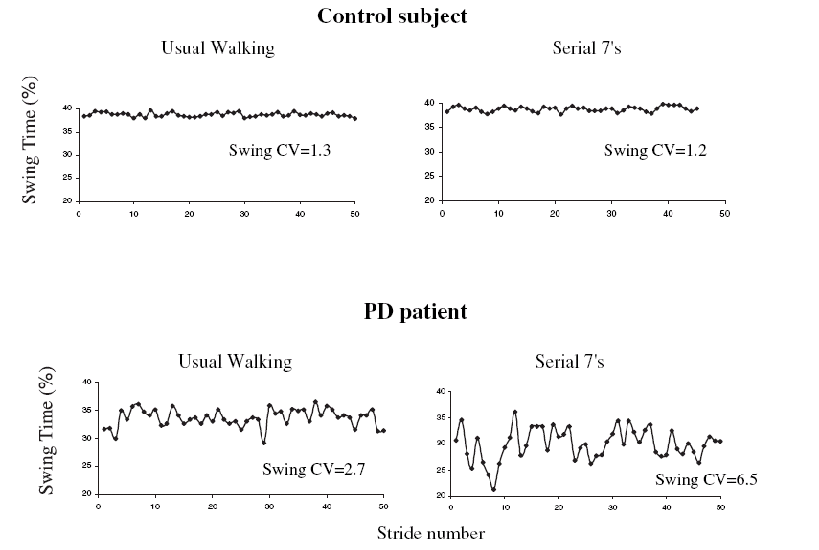
A subset of the database includes measures recorded as subjects performed a second task (serial 7 subtractions) while walking, as in the figure above, which shows excerpts of swing time series from a patient with PD (lower panels) and a control subject (upper panels), under usual walking conditions (at left) and when performing serial 7 subtractions (at right). Under usual walking conditions, variability is larger in the patient with PD (Coefficient of Variation = 2.7%), compared to the control subject (CV = 1.3%). Variability increases during dual tasking in the subject with PD (CV = 6.5%), but not in the control subject (CV = 1.2%). From Yogev et al. (reference [4] below).
References
- Frenkel-Toledo S, Giladi N, Peretz C, Herman T, Gruendlinger L, Hausdorff JM. Effect of gait speed on gait rhythmicity in Parkinson's disease: variability of stride time and swing time respond differently. Journal of NeuroEngineering and Rehabilitation 2005: 2:23.
- Frenkel-Toledo, S, Giladi N, Peretz C, Herman T, Gruendlinger L, Hausdorff JM. Treadmill walking as a pacemaker to improve gait rhythm and stability in Parkinson's disease. Movement Disorders 2005; 20(9):1109-1114.
- Hausdorff JM, Lowenthal J, Herman T, Gruendlinger L, Peretz C, Giladi N. Rhythmic auditory stimulation modulates gait variability in Parkinson's disease Eur J Neuroscience 2007; 26: 2369-2375.
- Yogev G, Giladi N, Peretz C, Springer S, Simon ES, Hausdorff JM. Dual tasking, gait rhythmicity, and Parkinson's disease: Which aspects of gait are attention demanding? Eur J Neuroscience 2005; 22:1248-1256.
Contributors
For more information about PD, see Parkinson's Disease: Hope Through Research at the NIH NINDS web site, and Living With Parkinson's at the web site of the Michael J. Fox Foundation for Parkinson's Research.
This work was supported in part by grants from the National Institutes of Health, National Parkinson Foundation, and the Parkinson's Disease Foundation and was collected at the Laboratory for Gait & Neurodynamics, Movement Disorders Unit of the Tel-Aviv Sourasky Medical Center. For more information, please contact Dr. Jeffrey M. Hausdorff (jhausdor@tasmc.health.gov.il or jhausdor@bidmc.harvard.edu).
Cited by
8 publications cite this project. The most recent are listed below.
-
Multimodal Machine Learning Approach for Timed-Up-and-Go Test Score Prediction from Wearable Gait Data
Nabid Faiem, Tunç Aşuroğlu, Koray Açıcı et al. Communications in computer and information science, 2026. -
Explainable AI Highlights the Most Relevant Gait Features for Neurodegenerative Disease Classification
Gianmarco Tiddia, Francesca Mainas, Alessandra Retico et al. Applied Sciences, 2025. -
A review of machine learning and deep learning for Parkinson’s disease detection
Hajar Rabie, Moulay A. Akhloufi. Discover Artificial Intelligence, 2025. -
Evaluating Motor Symptoms in Parkinson’s Disease Through Wearable Sensors: A Systematic Review of Digital Biomarkers
Carlos Polvorinos-Fernández, Luis Sigcha, Luigi Borzì et al. Applied Sciences, 2024. -
Assessment of Parkinson’s Disease Severity Using Gait Data: A Deep Learning-Based Multimodal Approach
Nabid Faiem, Tunç Aşuroğlu, Koray Açıcı et al. Communications in computer and information science, 2024.
Citation data from OpenAlex. Papers that use the project without citing it may be missing.
Files
Total uncompressed size: 288.4 MB.
Access the files
- Download the ZIP file (288.4 MB)
-
Download with the PhysioNet Python package:
physionet download gaitpdb --version 1.0.0
-
Download the files using your terminal:
wget -r -N -c -np https://physionet.org/files/gaitpdb/1.0.0/
-
Download the files using AWS command line tools:
aws s3 sync --no-sign-request s3://physionet-open/gaitpdb/1.0.0/ DESTINATION